
Amir Schmidt · 24 October 2026
Soil Microbes Adapt as Extended Haze Events Transform Nutrient Cycles in Misty Valleys
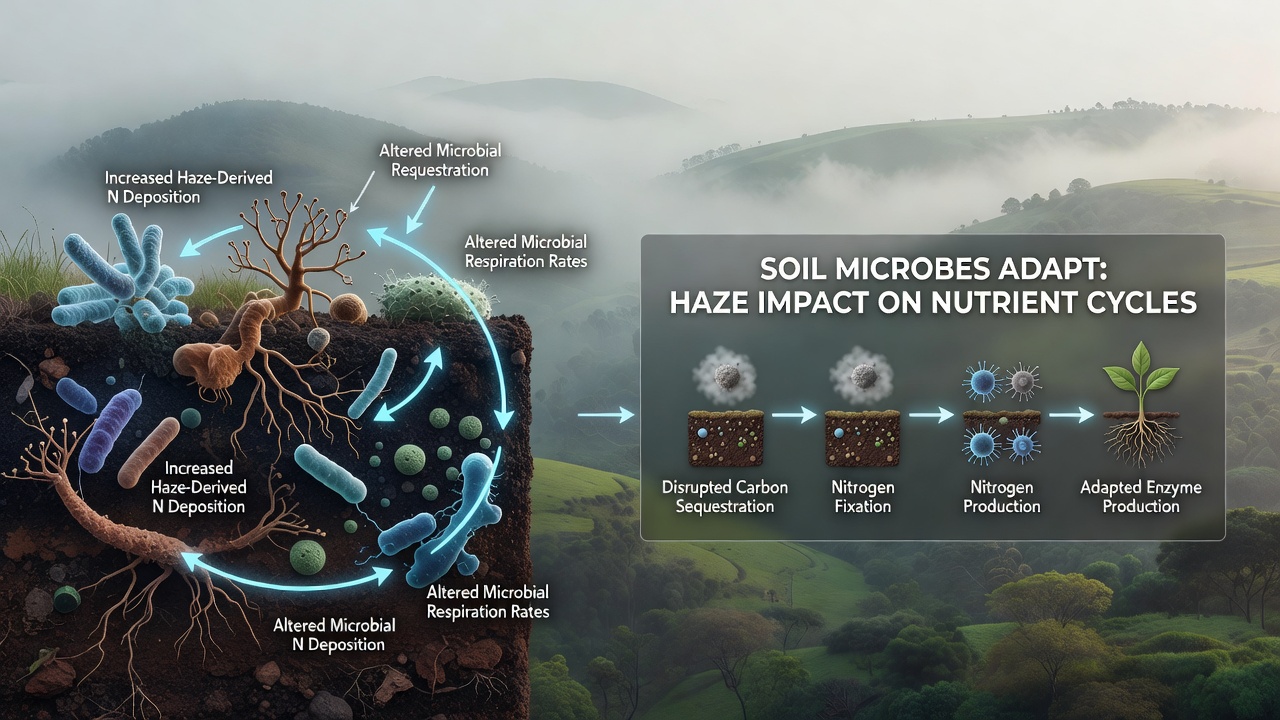
Extended haze periods have altered soil conditions across misty valley regions, prompting shifts in microbial populations that manage nutrient breakdown and redistribution. Data collected through 2026 shows haze events lasting several weeks at a time have reduced sunlight penetration while increasing deposition of fine particles that carry nitrogen compounds and trace metals into surface soils. Researchers monitoring these valleys note that microbial communities respond by reallocating enzymatic activity toward different decomposition pathways.
Haze Duration and Soil Chemistry Changes
Measurements taken in October 2026 recorded haze layers persisting beyond 25 days in several valley basins, a pattern that differs from shorter fog events documented in prior decades. These prolonged conditions limit photosynthesis in understory plants, which in turn reduces fresh organic inputs to the soil. At the same time, haze particles settle and release ammonium and nitrate forms that microbes can access directly. Soil pH readings have shown slight declines in upper layers because of the added acidic compounds, yet deeper horizons maintain more stable conditions.
Nutrient cycle models developed by teams at the University of British Columbia indicate that phosphorus availability rises temporarily when haze-derived metals bind with existing soil phosphates and then release them through microbial weathering. EPA studies on atmospheric deposition provide comparable data from forested catchments where similar particle inputs have accelerated short-term nitrogen turnover rates.
Microbial Response Patterns
Bacterial and fungal groups have demonstrated measurable adjustments in community structure during extended haze intervals. Actinobacteria populations increase in surface samples because they tolerate lower oxygen levels created when haze reduces daytime temperatures and slows evaporation. Fungal networks, particularly those forming mycorrhizal associations, extend hyphal growth to reach new nutrient patches created by uneven particle deposition. Gene expression analyses reveal upregulation of genes linked to denitrification, allowing certain bacteria to process excess nitrates before they leach into groundwater.
Observed Shifts in Enzyme Activity
Enzyme assays from valley plots sampled in late 2026 show elevated phosphatase activity in haze-affected zones compared with clearer periods. This increase aligns with greater demand for phosphorus as haze particles introduce additional binding sites. Cellulase production declines in the same samples, reflecting reduced plant litter input when light levels stay low for weeks. Such coordinated changes illustrate how microbes rebalance their resource acquisition strategies rather than simply increasing or decreasing overall metabolic rates.
Regional Data and Comparative Studies
Long-term monitoring stations across multiple misty valley sites have compiled datasets that link haze duration directly to changes in soil respiration rates. Figures from October 2026 campaigns show respiration dropping by 18 to 22 percent during peak haze weeks before rebounding once skies clear. Australian researchers at CSIRO have published parallel findings from coastal fog belts where microbial adaptation timelines follow similar trajectories, suggesting the response mechanism operates across different climate zones.
One study tracked isotope-labeled nitrogen through the soil profile and found that haze-derived ammonium moved into microbial biomass within five days, whereas nitrate conversion required closer to twelve days. These timelines help explain why certain microbial taxa dominate during extended events while others remain dormant until conditions shift.
Nutrient Cycling Implications
Transformed nutrient flows affect plant uptake patterns in subsequent growing seasons. Valleys that experienced repeated haze events show higher residual nitrogen in mineral forms at the start of spring, which can support early root growth but also raises the risk of leaching if rainfall increases. Phosphorus that microbes mobilize during haze periods tends to remain in organic complexes, reducing immediate availability but building a longer-term reserve that fungi can access later.
Observers tracking these cycles emphasize that microbial adaptation occurs through existing genetic diversity rather than rapid evolution, allowing communities to maintain function across variable atmospheric conditions. The same stations that recorded October 2026 haze layers continue to sample microbial DNA monthly to detect any cumulative shifts that might persist beyond individual events.
Conclusion
Soil microbial communities in misty valleys adjust their metabolic priorities and community composition when haze events extend for weeks, leading to measurable changes in nitrogen and phosphorus cycling. Data from 2026 demonstrates these adjustments through altered enzyme profiles, respiration rates, and nutrient movement timelines. Continued monitoring at established sites will clarify whether these responses represent temporary accommodations or longer-term modifications to valley soil systems.